 I’m one of the many who believe that video games not only can be a form of art, they can also be a literary medium. Want proof? Look no further than Silent Hill 2’s gripping narrative and try to tell me that that’s not on par with a Steven King or Clive Barker. Check out Ico’s emotionally moving story. Even Bungie’s Halo and Bioware’s Mass Effect have introduced players to science fiction universes on scale with a Star Wars or Battlestar Galatica. However, if gaming is to progress as an entertainment medium, it’s not enough to present an quirky art style or a deep plot. Gaming has to be able to explore taboo and even controversial subjects just like books, movies, and television shows do, even if they may get somewhat offensive or politically incorrect (which is why I was disappointed when 6 Days in Fallujah ended up being indefinitely postponed, but that’s another story). Of course I’m not saying that a developer should go out and create ‘KKK Lynchin’ Heroes’, but if and when done correctly, video games can provide a light with which to look at social issues that continue to affect us today. Beyond Good and Evil could be considered a commentary on the role of the press and the distribution of information during times when civil freedoms are being challenged, and Metal Gear Solid 4’s storyline about private military corporations can be considered a look at military policy, particularly in the wake of the Blackwater scandal. However, few issues have been more hotly debated than that of violence in our schools, and no one moment in our history better exemplifies the issue than the Columbine Massacre.
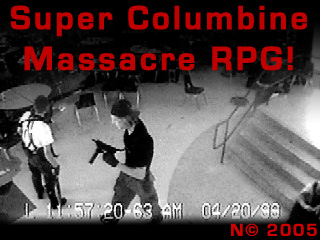
For those of you who don’t know the story, on April 20th of 1999, Eric Harris and Dylan Klebold, two troubled teens who had apparently been bullied during their years in high school went on a violent shooting spree, killing over a dozen students and teachers. The media, parents/teacher groups, clergymen, and opportunistic politicians, unable to fathom that two white boys from a wealthy suburban community bought about something that apparently is only supposed to happen in the ghetto or a backwoods rural area (and with rumors of a so-called ‘trenchcoat mafia’ shut down), immediately set about finding things to blame the tragedy on. “It was because of easy access to guns!” “It was because gun control laws are too strict!” “It was Marylin Manson!” “It was violent video games!” “It was Doom!” “It was because of the evil liberals taking prayer out of schools!” “Where were the parents at?” “Why didn’t anyone see the warning signs?” With all the fuss in a search for a scapegoat, few even considered to take a look at the events in their lives that might have led up to the shooting. Enter independent developer Danny Ledonne. Using the program RPG Maker 2000, he created a game which places characters in the role of the shooters. By researching thousands of pages of news articles about the massacre, home videos the two killers made, and video news reports, Ledonne’s product gives an insight and paints a picture suggesting why such a tragedy occurred.
[Read the rest of this entry…]


 PS3
PS3
 Famicom Dojo
 KEEP PLAYING
 KEEP PLAYING: Rewind
 Powet Toys
 Powetcast
 Hitchhiker's Guide POWETcast











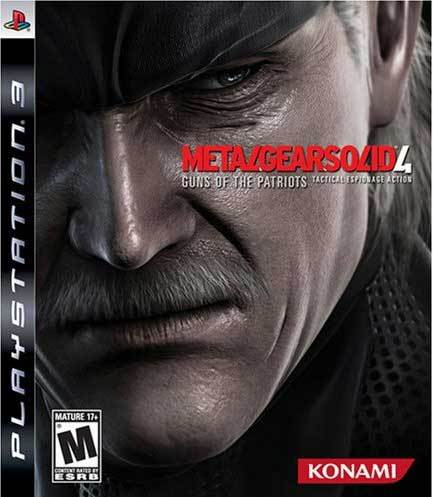 Hideo Kojima’s masterpiece is most likely the reason you bought a PS3, and for good reason. Like its predecessors, Metal Gear Solid 4 bends the rules of video game convention to become a landmark for its generation of gaming, and like its predecessors, it deserves a space on your shelf.
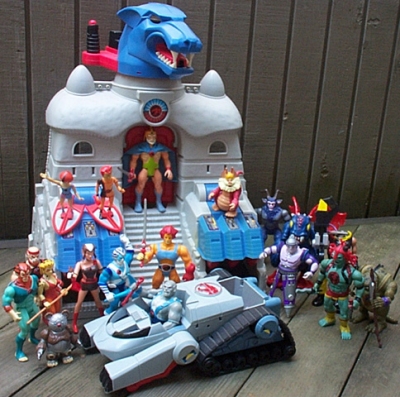
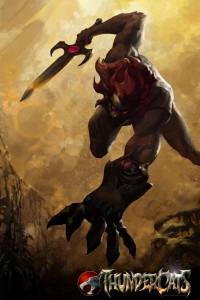 Warner Bros has announced they plan to relaunch Thundercats with a new animated series set to debut on Cartoon Network. A date has not been announced, but it will be co-produced by Warner Bros Animated and Studio4°C in Japan.